


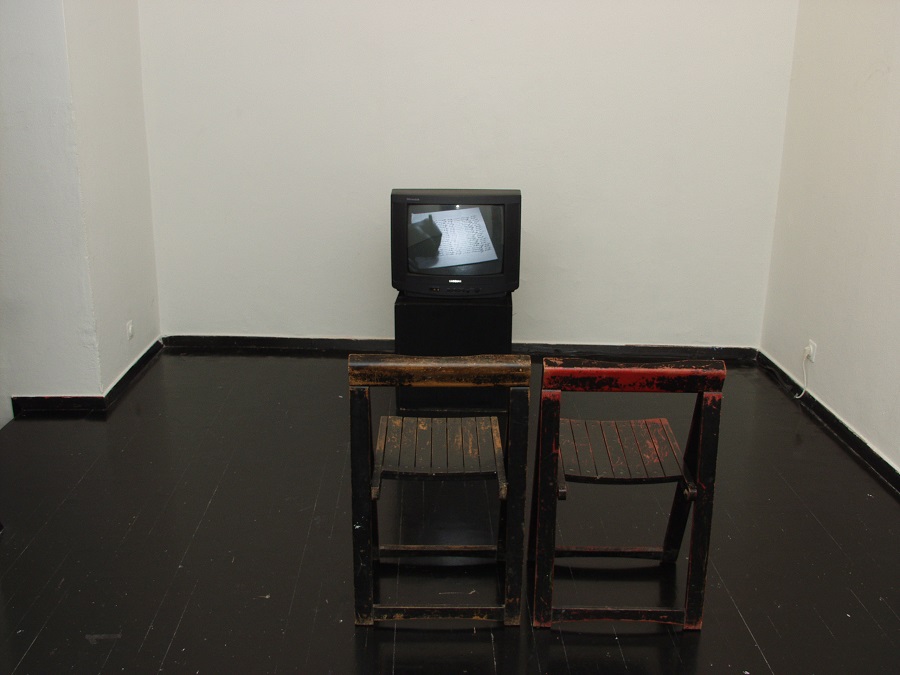

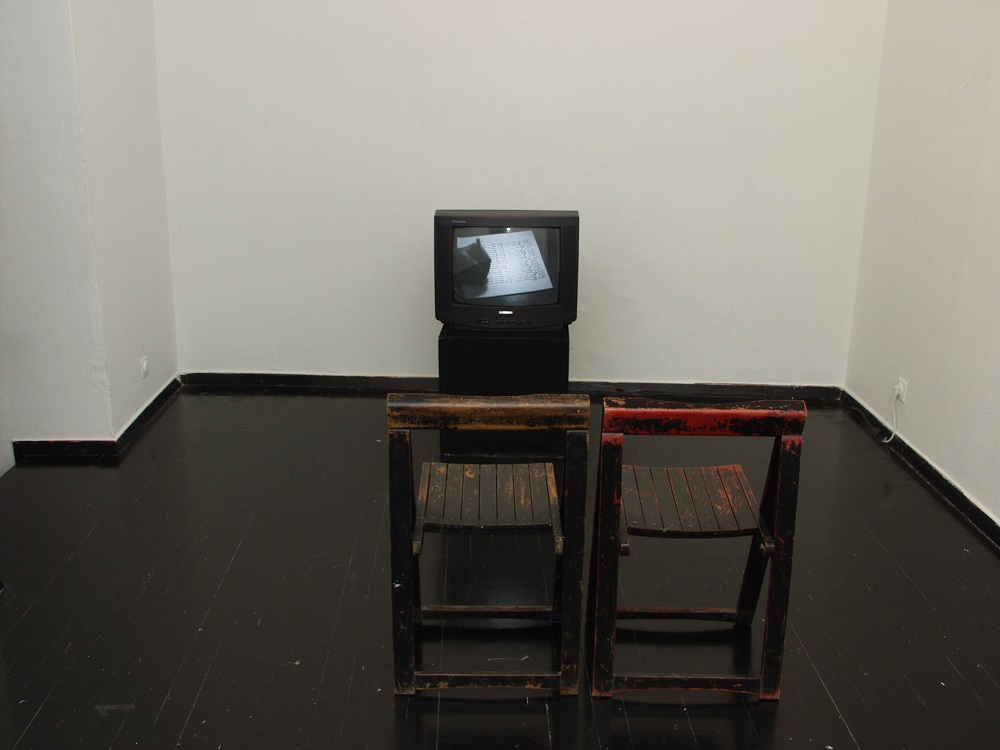
The exhibition Between Fire and Art is a concluding part of the seventh edition of the Course for Curators of Contemporary Arts that takes place in frame of the World of Art: School for Contemporary Arts, organized by SCCA, Center for Contemporary Arts-Ljubljana.
Artworks exhibited under the title Between Fire and Art speak about a decisive moment in an artist’s creative work and personal life. They explore a point where the artist makes a break with her/his past. In the process of making a break, artists use an area, which infuses their life-art. Their artistic work stands for a process of cleansing, a kind of personal ritual with which they confront the past. Such an act can be comprehended as a catharsis that enables the artist, and through him also the audience, to continue with her/his life or artistic practice. The openness of such an act seems especially courageous for Slovenian milieu, which is, considering its past and smallness, still very reserved. Moreover, it is rare also in artistic practices of other countries. That makes it even more interesting.
Despite differences of standpoints and artistic expressions, their common reference lies in the conceptual art, which has, in 60s, infused especially the western world of art. The exhibition tries to follow the stream of development of this direction of art and the way of its manifestation. Through the works we get to know two different points of view. The first one follows the western mentality, based on rationalism, present in the foundation of modern sciences and their epistemologies. Here, the intellect is a sign for ascertainment of the truth. The second pole follows the so-called era of emotions. The interest for emotions, the inner world of an individual and her/his intimacy, is characteristic for the second part of the 20th century and is an answer to the Zeitgeist of the 60s. Consequently, we find ourselves at a rupture of two practices, two points of view. On one side, the exploring of individual’s technocracy with disdain of one’s personality, needs and initiatives, and on the other side, an exaggerated emphasis on these traits. The connection between these two points of view is the one that deepens the exhibition, softens the possible ‘pathos’ of single stories and gives it a critical dimension, so it can stand on the second, maybe even ironical, pole.
The exhibition raises questions and partly tries to answer them. At the same time, it leaves the viewer a choice to enter the space of artworks in an intimate flirtation, to submit to their power of inner fulfillment and let the works lead her/him toward the answers.
Škuc Gallery, Ljubljana
23/6/2004 - 24/7/2004
Marina Abramović & Ulay, John Baldessari, Borut Hlupič, Željko Jerman
Vesna Čadež, Petra Kapš, Tevž Logar, Alja Mravljak, Andrej Savelli, Jasmina Založnik and Špela Zidar
Nevenka Šivavec, Tadej Pogačar
SCCA, Centre for Contemporary Arts-Ljubljana; WORLD OF ART: School for Contemporary Arts - Course for Curators of Contemporary Arts 2003/04
June 23, 2004